The concept of a quantum network represents a promising blueprint for the advancement of quantum information technology, within which quantum secure communication plays a pivotal role. Quantum key distribution (QKD) protocols, grounded in the fundamental principles of quantum mechanics, offer two users the ability to share a key with unconditional information-theory security. Over the past decades, significant progress has been made in both the theoretical and experimental aspects of QKD, and its practical applications have become increasingly mature. Building on this foundation, extending the two-user QKD to a multi-user quantum cryptographic conferencing (QCC) is a crucial step towards the realization of a quantum network. Writing in Physical Review Letters, the group of Prof. Xiao-Song Ma at Nanjing University reports experimental demonstration of measurement-device-independent QCC (MDI QCC) network, paving the way for practical multi-user quantum communication networks.
The QCC protocols enable multiple participating users to share the same secure key, requiring the establishment of multipartite quantum correlation among the users to ensure security. Compared to entanglement-based protocols that directly prepare and distribute multi-photon entanglement states, the measurement-device-independent (MDI) protocol based on entangled state projection measurement is immune to all attacks targeting the detection side, thus offering higher security and practicality. As in well-known MDI QKD protocols that two-photon Bell states are post-selected, MDI-QCC protocol can post-select three-photon GHZ states by the GHZ-state analyzer. The polarization-encoding MDI QCC protocol was first proposed in 2015 (Phys. Rev. Lett. 114, 090501), and the door to research on MDI QCC has thus been opened. However, due to experimental challenges such as low multi-fold coincidence count rates, the MDI QCC protocol has not yet been successfully implemented in experiments for a long time.
Here the excitement as Yifeng Du and colleagues in the group of Xiao-Song Ma now report the experimental demonstration of polarization-encoding MDI QCC protocol.
To realize the MDI QCC protocol, the group on the one hand made theoretical improvements by upgrading the original three-intensity protocol to a four-intensity protocol. Under conditions of limited transmitted pulse numbers and low coincidence count rates, the new protocol significantly enhances the secure key rate compared to the original protocol, while also extending the communication distance. On the other hand, the group theoretically investigated and experimentally demonstrated the multi-photon interference phenomenon in the GHZ-state projection measurement with weak coherent state. Finally, the group established a three-user communication network and ultimately achieved conference key rates of approximately 7.54 bps, 1.17 bps, and 0.097 bps under overall system losses of about 14.1 dB, 17.8 dB, and 21.5 dB, respectively. Recently, a team from the Southern University of Science and Technology completed related work (Phys. Rev. Lett. 133, 210803), advancing, alongside this work, the development of practical, multi-user quantum networks.
The work of Ma's group is an fundamental work in the research of MDI QCC, which not only demonstrates the feasibility of the protocol, but also provides an important reference for the establishment of MDI-QCC networks with higher key rate and longer communication distance. In addition, by combining the MDI QKD and MDI QCC protocol based on this work, we can continue to make strides towards the establishment of the scalable, long-distance, large-scale quantum communication networks.
The first author of the article is Yifeng Du, a Ph.D. candidate at the School of Physics, Nanjing University. Yufeng Liu, Chengdong Yang, and Xiaodong Zheng also made significant contributions to this work. Professor Xiao-song Ma from the School of Physics, Nanjing University, is the corresponding author of the article. Academician Shining Zhu from Nanjing University provided in-depth guidance for this research. This work was supported by the National Key Research and Development Program of China, the National Natural Science Foundation of China, the Leading-Edge Technology Program of Jiangsu Natural Science Foundation, the Fundamental Research Funds for the Central Universities, and Innovation Program for the Quantum Science and Technology. Additionally, this work received support from the School of Physics at Nanjing University, the National Laboratory of Solid-state Microstructures, the Collaborative Innovation Center of Advanced Microstructures, the Synergetic Innovation Center of Quantum Information and Quantum Physics at the University of Science and Technology of China, and the Hefei National Laboratory.
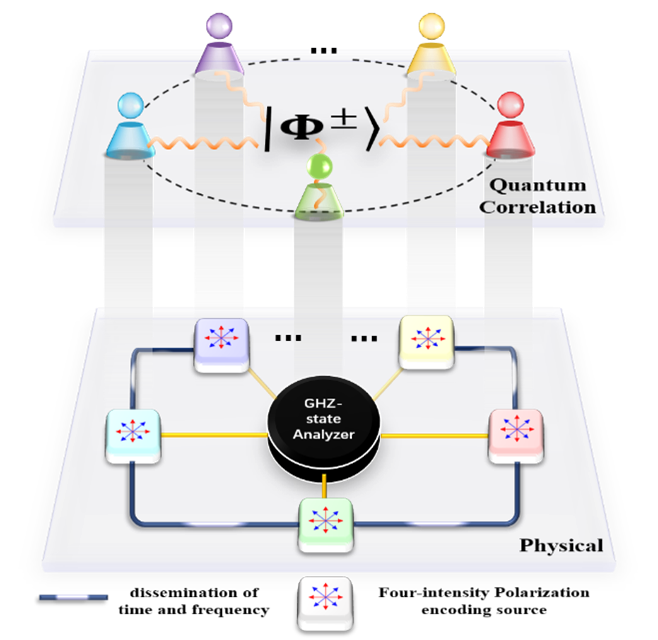
Fig: Scheme of polarization encoding MDI QCC. In physical layer, multiple users participating in conference randomly prepare polarization-encoded four-intensity pulses with the help of dissemination of time and frequency for synchronization and frequency difference suppression. They send pulses to the GHZ-state analyzer at untrusted detection node for GHZ-state projection measurements. In quantum correlation layer, GHZ-state correlation among all users is generated from successful GHZ-state projection measurement events.